 2026-07-10
 Content
A standard gas spring is built to deliver one fixed amount of force for its entire service life. Adjustable gas springs are different — they let you change the internal gas pressure (and therefore the extension force) after installation, without replacing the whole unit. This matters in any application where the load on the spring changes over time, or where different users need different amounts of resistance from the same mechanism. Instead of stocking a dozen fixed-force gas struts to cover a range of weights, manufacturers and end users can install one adjustable gas spring and dial it in on site.
This flexibility is why adjustable gas springs have become common in furniture, medical equipment, industrial machinery, and automotive applications. A single adjustable unit can often replace several fixed-force variants, which simplifies inventory, reduces the risk of ordering the wrong part, and makes future maintenance easier.
Inside a gas spring is a sealed cylinder containing compressed nitrogen gas and a piston rod. As the rod is pushed in, the gas compresses further and pushes back, creating the extension force. In an adjustable gas spring, the cylinder includes a valve or fill port that allows technicians to add or release gas, changing the internal pressure and, with it, the amount of force the spring produces.
Some adjustable gas springs use a manual knob or dial connected to a metering valve, letting the end user increase or decrease resistance in real time — this is common in office chairs and adjustable desks. Others are designed for one-time calibration during installation, where a technician sets the pressure to match a specific load and then locks it in place. Both approaches rely on the same core principle: controlling gas volume and pressure inside a sealed cylinder to produce a tunable force output.
Adjustable gas springs show up anywhere a lid, panel, seat, or platform needs to move smoothly and hold position under varying loads. Understanding these use cases helps clarify which type of adjustment mechanism is worth paying for.
Office chairs, height-adjustable desks, and recliners use adjustable gas springs so a single product can comfortably support users of different weights. The adjustment is usually made through a lever or knob accessible to the end user.
Machine guards, tailgates, engine covers, and access panels often carry loads that vary depending on configuration or added components. Adjustable gas springs let technicians fine-tune the force during installation so the panel opens smoothly and stays in position without slamming or drifting shut.
Adjustable examination tables, imaging equipment, and lab benches need precise, repeatable resistance to support delicate positioning tasks. Adjustable gas springs allow fine calibration that fixed-force units cannot match.
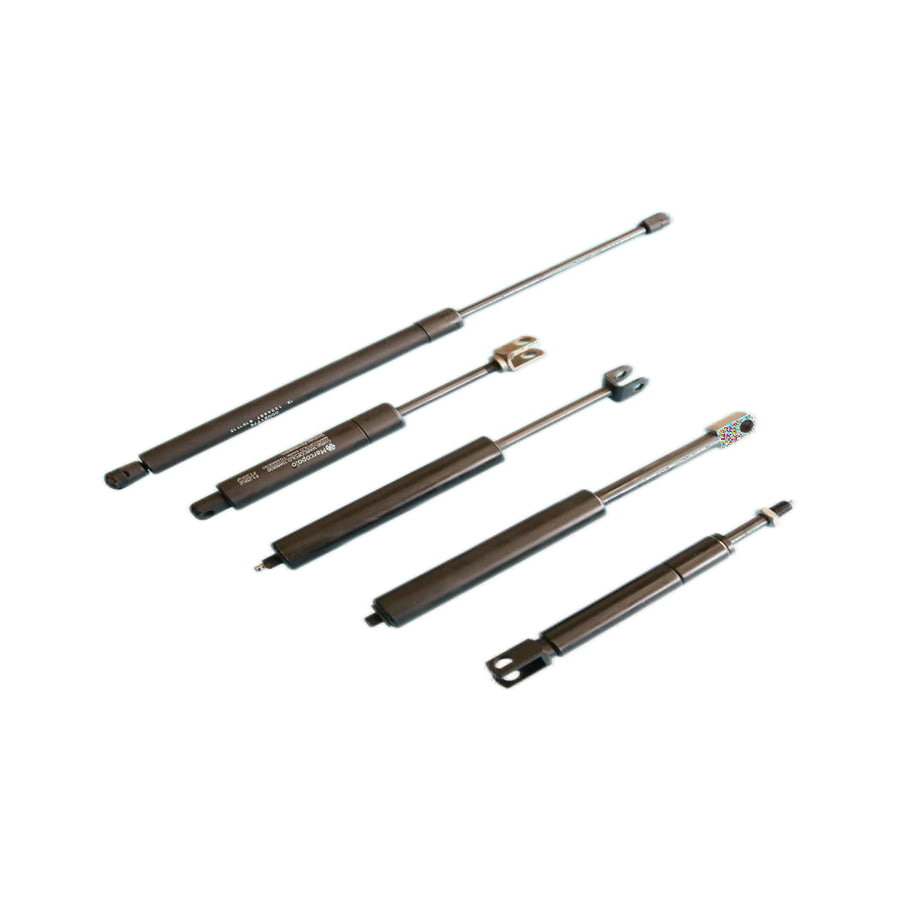
Not all adjustable gas springs are built for the same duty cycle or environment. Before ordering, compare these specifications against your actual application requirements.
| Specification | Why It Matters |
| Adjustable Force Range | Determines how wide a load range a single unit can cover without replacement |
| Stroke Length | Must match the travel distance of the panel, seat, or lid being supported |
| Adjustment Mechanism | Manual dial vs. valve-based calibration affects ease of use and precision |
| Seal and Rod Coating | Affects corrosion resistance and lifespan in outdoor or humid environments |
| Mounting Type | Ball stud, eyelet, or clevis mounts need to match existing hardware |
| Cycle Rating | Indicates how many extension/compression cycles the spring is rated to endure |
The adjustment process depends on the mechanism built into the spring, but most fall into one of two categories.
Common in chairs and desks, this type uses an external knob connected to an internal valve. Turning the knob releases or restricts gas flow within the cylinder, immediately changing the resistance felt by the user. This method requires no tools and can be adjusted repeatedly during normal use.
Industrial and automotive adjustable gas springs often use a fill valve that requires a pressure gauge and charging tool. A technician connects the tool, adds or releases nitrogen gas in small increments, and tests the panel or lid until it holds position correctly. This method is more precise but is typically done during installation or servicing rather than by the end user.
Most issues with adjustable gas springs trace back to gas leakage, worn seals, or incorrect initial calibration. Recognizing the symptoms early can prevent a full replacement.
Adjustable gas springs are largely maintenance-free by design, but a few habits noticeably extend their working life, especially in industrial or outdoor settings.
Because adjustable gas springs are often used in safety-relevant applications — supporting machine guards, medical equipment, or vehicle panels — the supplier's quality control matters as much as the part number. Ask for the rated cycle life under real-world conditions, confirm what corrosion-resistance options are available for outdoor use, and check whether the adjustment mechanism can be serviced or recharged rather than requiring full replacement when pressure drops.
A supplier who can provide clear documentation on force range, stroke length, and mounting compatibility — along with responsive technical support for calibration questions — is generally a safer long-term choice than one offering the lowest price with limited specifications.
 Category

 English
 中文简体
中文简体 عربى
عربى Español
 +86-13861233850