 2026-03-02
 Content
When engineers and procurement specialists evaluate motion control components, two names frequently appear side by side: gas springs and hydraulic dampers. While both devices manage mechanical movement, they operate on fundamentally different principles and serve distinct purposes. Confusing the two can lead to costly specification errors, reduced equipment lifespan, or even safety issues on the production floor. Understanding their core differences is essential for anyone working with industrial machinery, automotive assemblies, or precision equipment.
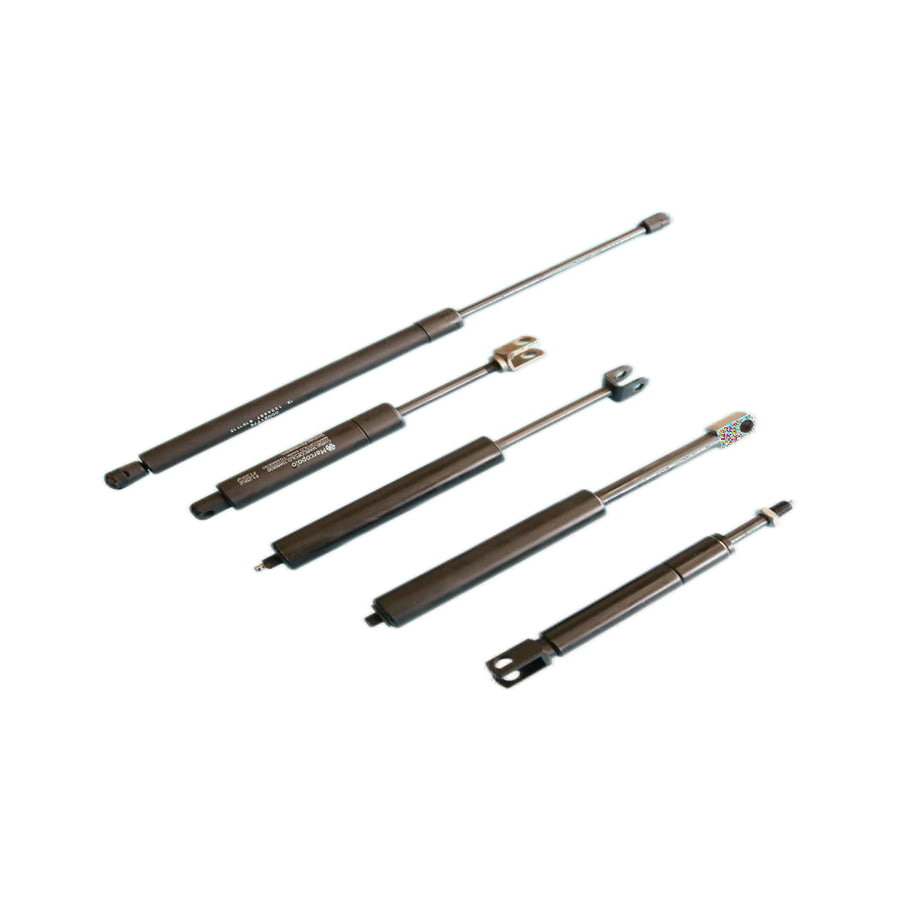
Industrial gas springs are sealed cylinders filled with compressed nitrogen gas. When an external force compresses the cylinder, the gas pressure increases and stores energy. Upon release, that stored energy pushes the piston rod back out, creating a controlled extension force. This makes gas springs inherently active devices—they exert force even at rest and assist in lifting, pushing, or holding components in a specific position.
Hydraulic dampers, by contrast, use hydraulic fluid forced through small orifices to resist motion. They are passive, reactive devices. A hydraulic damper generates resistance only when movement occurs, converting kinetic energy into heat through fluid friction. The faster the movement, the greater the resistance the damper produces. They do not store or return energy—they simply absorb and dissipate it.
The force behavior of gas springs is largely determined during manufacturing. The internal nitrogen pressure, piston diameter, and rod diameter together define the output force. Most industrial gas springs maintain a relatively consistent force throughout their stroke, though some variation exists due to gas compression. This predictability makes them ideal for applications requiring consistent lifting assistance or counterbalancing, such as machine tool covers, inspection hatches, and ergonomic workstation components.
Hydraulic dampers produce velocity-dependent force. The resistance increases proportionally—or sometimes progressively—with the speed of movement. This characteristic is particularly valuable in applications where sudden impacts or high-speed motions must be absorbed without transmitting shock loads to surrounding structures. Industrial machinery doors, robotic end-of-stroke cushioning, and vehicle suspension systems all benefit from this behavior.
Some advanced products combine both technologies into a single unit, often called a gas spring with integrated damping. These hybrid components provide the lifting force of a gas spring alongside the controlled deceleration of a damper, making them suitable for applications where both support and smooth motion are required simultaneously.
The clearest way to differentiate the two is to look at where each is deployed in real industrial environments. Gas springs are widely used wherever a component needs to be held open, lifted with minimal operator effort, or balanced against gravity. Hydraulic dampers are chosen wherever energy absorption, vibration isolation, or controlled deceleration is the primary need.
Common applications for industrial gas springs include:
Common applications for hydraulic dampers include:
A direct comparison helps clarify when each component is the right choice for a given specification:
| Feature | Industrial Gas Springs | Hydraulic Dampers |
| Primary function | Store and release energy | Absorb and dissipate energy |
| Force type | Position-dependent | Velocity-dependent |
| Active at rest? | Yes | No |
| Working fluid | Compressed nitrogen | Hydraulic oil |
| Temperature sensitivity | Moderate (gas expands with heat) | Higher (oil viscosity changes) |
| Typical lifecycle | 50,000–100,000+ cycles | Varies widely by design |
Industrial gas springs are largely maintenance-free over their service life. Because they rely on sealed nitrogen gas, there are no external fluid lines, pumps, or reservoirs to manage. The main failure mode is seal degradation, which causes gradual pressure loss and reduced extension force. Most manufacturers rate their gas springs for tens of thousands of cycles under normal operating conditions. When a gas spring does fail, replacement is typically straightforward since standard mounting interfaces are widely adopted across the industry.
Hydraulic dampers require more attention, particularly in harsh industrial environments. The hydraulic fluid can degrade over time due to heat cycling, contamination, or emulsification if moisture enters the system. Seals are also a wear point, and a leaking hydraulic damper can introduce fluid contamination into clean production environments—a concern in food processing, pharmaceutical, and semiconductor manufacturing settings. Some hydraulic dampers are designed as sealed, serviceable units, while others allow for fluid replenishment and seal replacement.
Temperature plays a significant role in both technologies but affects them differently. Gas springs experience slight force variation as temperature changes the pressure of the nitrogen charge—typically a few percent across common industrial temperature ranges. Hydraulic dampers are more sensitive because oil viscosity changes substantially with temperature, which directly alters damping force. In extreme cold, a hydraulic damper may become too stiff; in high heat, it may lose damping effectiveness. Specifying the right fluid grade and seal material for the operating environment is critical.
The decision between gas springs and hydraulic dampers should always start with a clear definition of the functional requirement. Ask whether the primary need is to support, lift, or hold a load—or to slow down, absorb shock, or reduce vibration. The former points to gas springs; the latter to hydraulic dampers. In many complex machines, both components are used together, with gas springs providing counterbalance and hydraulic dampers ensuring controlled, smooth motion throughout the stroke.
Also consider the installation environment. Gas springs perform reliably across most standard industrial conditions and require minimal integration effort. Hydraulic dampers may demand more careful mounting orientation, temperature management, and periodic inspection schedules. Budget for lifecycle costs, not just unit price, when comparing options for high-cycle applications.
Finally, consult with component manufacturers early in the design phase. Both gas spring and hydraulic damper suppliers can provide application engineering support, helping translate your load, stroke, speed, and environment requirements into a precise specification. Getting this right from the start prevents costly redesigns and ensures the long-term reliability of your equipment.
 Category

 English
 中文简体
中文简体 عربى
عربى Español
 +86-13861233850