 2026-05-25
 Content
Stainless steel pipe fittings are mechanical components used to connect, redirect, terminate, or branch piping runs in fluid and gas handling systems. They are manufactured from stainless steel alloys — iron-based metals containing a minimum of 10.5% chromium by mass — which form a self-repairing passive oxide layer on the surface that provides outstanding resistance to corrosion, oxidation, and chemical attack. This combination of mechanical strength, corrosion resistance, hygienic surface properties, and temperature tolerance makes stainless steel pipe fittings the material of choice across food and beverage processing, pharmaceutical manufacturing, chemical plants, oil and gas installations, marine systems, and architectural plumbing wherever carbon steel or plastic fittings would corrode, contaminate, or fail under service conditions.
The term stainless steel pipe fitting covers an extremely wide range of products — from a simple half-inch threaded elbow used in a commercial kitchen water line to a large-diameter schedule 80 butt-weld reducer in a petrochemical refinery — but all share the fundamental properties that distinguish stainless steel from other fitting materials: dimensional stability across a wide temperature range, resistance to most acids, alkalis, and chloride environments at appropriate alloy grades, and a smooth internal bore surface that minimizes flow resistance and resists bacterial adhesion. These properties justify the higher unit cost of stainless steel fittings compared to carbon steel, brass, or plastic alternatives in applications where long service life, hygiene, or safety under pressure are non-negotiable.
Stainless steel pipe fittings are classified primarily by their function within a piping system. Each fitting type solves a specific piping geometry or connection problem, and specifying the correct type is the first step in any piping design or repair.
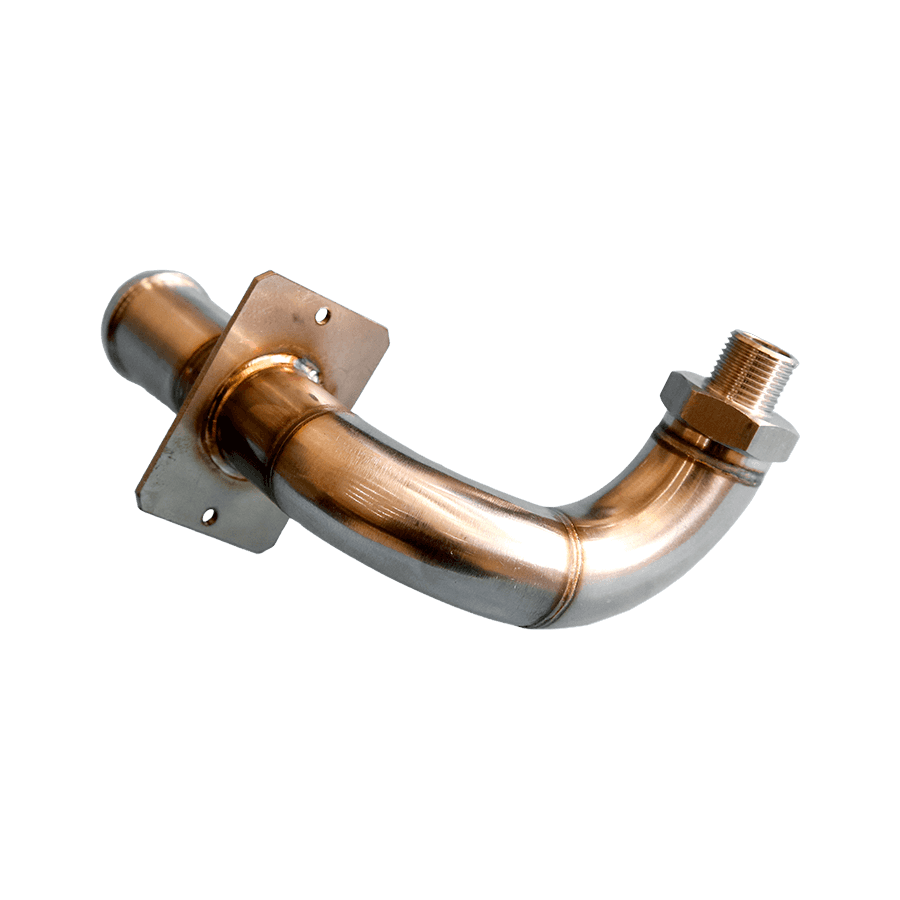
Elbows change the direction of flow within a piping system. The two standard angles are 90° and 45°, with 90° elbows being far more common. Stainless steel elbows are further classified by their bend radius: short-radius elbows (1D elbows, where the centerline bend radius equals the nominal pipe diameter) produce a tight directional change in a compact space but generate higher pressure drop and flow turbulence. Long-radius elbows (1.5D elbows, centerline radius = 1.5× pipe diameter) are the standard for most process piping because their gentler curve produces lower pressure drop, less erosion at the bend, and better flow characteristics. For slurry service, sanitary systems, or applications conveying viscous fluids, long-radius elbows — or even 3D and 5D radius bends — are specified to minimize product degradation and cleaning difficulty at tight bends. 180° return bends (U-bends) are used in heat exchanger headers and coil configurations.
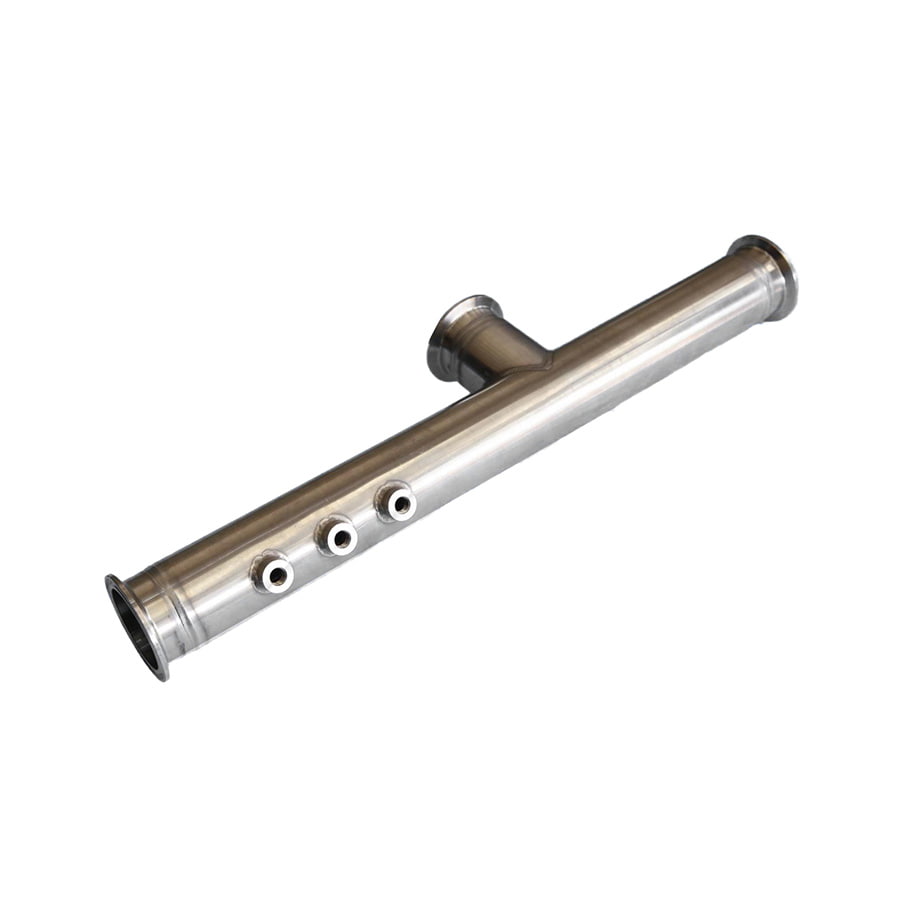
Tee fittings branch a piping run into two directions. An equal tee has the same bore diameter on all three outlets; a reducing tee has a smaller diameter on the branch outlet than on the run outlets, allowing a smaller branch line to be taken from a larger header without a separate reducer. Crosses (four-way fittings) branch in two perpendicular directions from a single fitting and are used where two branch lines must be taken from the same point in a system, though they are less common than tees due to their higher stress concentration under pressure and thermal cycling. In sanitary and hygienic stainless steel piping — used in food, dairy, beverage, and pharmaceutical systems — tees are designed with crevice-free, full-bore internal geometries to prevent product entrapment and support clean-in-place (CIP) cleaning without disassembly.
Reducers connect pipes of different diameters in a single straight run. Concentric reducers have the same centerline axis on both ends — the pipe diameter reduces symmetrically around the centerline — and are used in vertical pipe runs and where flow symmetry is important. Eccentric reducers have one flat side, which offsets the centerline of the larger and smaller bores. Eccentric reducers are specified in horizontal liquid lines where the flat-top orientation prevents air pocket formation at the reduction (critical in pump suction lines to avoid cavitation) and in bottom-flat orientation where drainage of the line is important. The length and angle of the reducer cone affects velocity transition and pressure recovery: a gradual taper (long reducer) minimizes head loss at the transition; an abrupt step change produces turbulence and should be avoided in high-velocity or high-purity applications.
Couplings join two pipe ends of the same diameter in a straight line. Full couplings connect two plain pipe ends; half couplings (or sockolets) are welded to the side of a larger pipe to create a branch connection point. Reducing couplings join pipes of different diameters without the gradual taper of a reducer — they are used for small diameter differences where the abrupt transition is acceptable. Unions are a three-piece coupling variant that can be disconnected without cutting or unthreading pipe from either side — a nut, a male end, and a female end — making them invaluable in locations where equipment must be regularly removed for maintenance, such as at instrument connections, pump inlet and outlet nozzles, and control valve installations.
Caps and plugs terminate pipe ends. Pipe caps fit over the outside of a pipe end and are welded, soldered, or threaded in place to close the line permanently or temporarily. Plugs insert into the bore of a threaded fitting or pipe end. Both are used to blank off unused branch connections, to pressure-test completed piping sections before connection to live systems, and to cap lines during phased construction. In stainless steel process systems, caps and plugs must be specified in the same alloy grade as the pipe and other fittings to prevent galvanic corrosion at the joint — mixing 304 SS caps with 316 SS piping, for example, is generally acceptable due to the small galvanic potential difference between these alloys, but mixing stainless steel with carbon steel or copper fittings requires careful assessment.
Nipples are short lengths of pipe with male threads on both ends, used to connect two female-threaded fittings. Close nipples (also called running nipples) have threads along their full length with no unthreaded section between them; hex nipples have a central hex section for wrench purchase. Bushings are threaded reducers with male thread on the outside and female thread on the inside, used to adapt a larger female-threaded fitting to accept a smaller male-threaded pipe or fitting. These small fittings are workhorses in instrumentation connections, utility headers, and anywhere that compact threaded connections are needed in stainless steel systems.
The connection method — how the fitting joins to the pipe — is as important as the fitting type in determining the pressure rating, leak integrity, disassembly capability, and installation cost of a piping joint. Stainless steel pipe fittings are available in four primary connection methods.
| Connection Type | Typical Pipe Size Range | Pressure Rating | Best For |
| Threaded (NPT/BSP) | 1/8" – 4" (DN6–DN100) | Up to Class 3000 (6,000 psi) | Utility, low-pressure, removable joints |
| Socket Weld | 1/8" – 2" (DN6–DN50) | Up to Class 3000/6000 | Small-bore high-pressure process piping |
| Butt Weld | 1/2" – 48"+ (DN15–DN1200+) | Full pipe rating (no reduction) | Process piping, high pressure, large diameter |
| Compression / Ferrule | 1/16" – 2" (instrumentation) | Up to 10,000 psi (tube OD dependent) | Instrumentation, tubing, removable joints |
Threaded stainless steel fittings use tapered NPT (National Pipe Taper, the US standard) or parallel BSP (British Standard Pipe, common in Europe, Asia, and most of the world outside North America) threads to make connections that seal through thread engagement and a thread sealant compound. NPT threads are self-sealing by taper — as the fitting is tightened, the tapered thread flanks wedge together to reduce the leak path — but require PTFE tape, pipe dope, or anaerobic thread sealant to achieve a bubble-tight seal. BSP parallel threads (BSPP) require a face seal (bonded washer or O-ring at the thread face) rather than a tapered seal; BSP taper threads (BSPT) function similarly to NPT. Threaded stainless fittings are rated in pressure classes (2000, 3000, and 6000 lb) corresponding to the wall thickness and thread engagement — a 3000 lb class ½" stainless elbow is rated for approximately 6,000 psi working pressure at ambient temperature.
Socket weld fittings have a recessed socket on each connection end into which the pipe is inserted to a defined depth before being fillet-welded around the outside of the joint. This design is simple to align, does not require pipe end preparation beyond squaring the cut, and produces a strong, full-strength joint when welded correctly. The internal crevice between the pipe end and the bottom of the socket — typically a 1.6 mm gap left before welding — is a known stress concentration and potential crevice corrosion site in chloride-containing service, which limits socket weld fittings to non-aggressive services or to situations where the crevice can be eliminated through full-penetration seal welding. ASME B16.11 is the governing standard for socket weld fitting dimensions in the US and is widely referenced globally.
Butt weld stainless steel fittings are the standard for all process piping above 2" nominal bore and for any service where full pipe-rated pressure capacity, radiographic weld inspection, or hygienic internal surface continuity is required. The fitting and pipe ends are beveled to a defined angle (typically 37.5° for a standard V-groove weld prep), aligned end-to-end, and fusion-welded with full penetration. A correctly executed butt weld joint has the same pressure rating as the parent pipe, no internal crevice, and a smooth internal profile that can be internally passivated or electropolished as a continuous surface. ASME B16.9 governs butt weld fitting dimensions for NPS ½" to 48"; wall thickness schedules (Schedule 5S, 10S, 40S, 80S) must match between pipe and fitting for correct fit-up and weld strength.
Stainless steel compression fittings — the most familiar being Swagelok and Parker A-Lok type twin-ferrule fittings — grip the outside of a tube using a hardened front ferrule that bites into the tube OD and a back ferrule that provides spring-back and vibration resistance when the nut is tightened. These fittings require no welding, produce leak-tight joints that can be remade multiple times, and are rated to very high pressures (up to 10,000 psi for small tube sizes) in stainless steel. They are the standard connection method for instrument tubing, sample systems, analyzer connections, hydraulic instrumentation, and laboratory gas lines. The key installation requirement is correct tube wall thickness and hardness — the tube must be harder than the fitting body for the ferrule to bite correctly; soft annealed tubing and hard-drawn tubing have different bite-in characteristics that affect leak-tightness at assembly.
Material grade selection is the most consequential decision in specifying stainless steel pipe fittings. The wrong grade in a corrosive environment will fail — sometimes catastrophically — while an unnecessarily high grade adds cost without benefit. These are the grades most commonly encountered in pipe fitting applications.
| Grade | UNS Number | Key Alloying Elements | Typical Application |
| 304 / 1.4301 | S30400 | 18% Cr, 8% Ni | General purpose, food, water, mild chemicals |
| 304L / 1.4307 | S30403 | 18% Cr, 8% Ni, low carbon | Welded assemblies, sensitization-sensitive service |
| 316 / 1.4401 | S31600 | 16% Cr, 10% Ni, 2% Mo | Marine, chloride environments, process chemicals |
| 316L / 1.4404 | S31603 | 16% Cr, 10% Ni, 2% Mo, low carbon | Welded process piping, pharmaceutical, food |
| 317L | S31703 | 18% Cr, 13% Ni, 3.5% Mo | Higher chloride resistance than 316L, pulp/paper |
| 2205 Duplex | S32205 | 22% Cr, 5% Ni, 3% Mo, N | High strength, chloride SCC resistance, offshore |
| 904L | N08904 | 20% Cr, 25% Ni, 4.5% Mo, Cu | Sulfuric acid, highly corrosive chemical service |
Grade 304 stainless steel — sometimes called 18/8 for its nominal 18% chromium and 8% nickel composition — is the most widely produced and stocked stainless steel grade globally and accounts for the majority of stainless steel pipe fittings used in plumbing, food service, dairy, water treatment, and general industrial applications. It provides excellent corrosion resistance in most non-chloride environments, good weldability, and a cost advantage over higher-alloyed grades. Grade 304L is the low-carbon variant (maximum 0.03% carbon versus 0.08% for standard 304) that is preferred for welded assemblies because its lower carbon content prevents carbide precipitation in the heat-affected zone during welding — a phenomenon called sensitization that can create intergranular corrosion susceptibility in service. In practice, most fitting suppliers now stock only 304L (which meets 304 mechanical requirements in the mill-annealed condition), and dual certification to both 304 and 304L is common.
The addition of 2–3% molybdenum to 316 grade stainless steel dramatically improves resistance to pitting and crevice corrosion in chloride-containing environments — seawater, coastal atmospheres, chlorinated cleaning solutions, and many chemical process streams. This makes 316 and 316L stainless steel pipe fittings the standard specification for marine installations, offshore platforms, coastal outdoor piping, pharmaceutical and biotechnology process systems (where the higher purity finish and molybdenum content together provide better resistance to the aggressive sanitizing chemicals used in CIP systems), and chemical process piping handling dilute acids, alcohols, and chloride-containing process streams. The rule of thumb used by many piping engineers is: use 304/304L for clean water, food-contact, and general mild-corrosion service; specify 316/316L wherever the service involves chlorides, saltwater, or chemical process streams.
Duplex stainless steels — with a microstructure approximately 50% austenite and 50% ferrite — offer approximately twice the yield strength of 304 or 316 austenitic grades, combined with excellent resistance to chloride stress corrosion cracking (SCC), which is the primary failure mode of 304 and 316 SS in high-temperature chloride service. Grade 2205 (the most common duplex grade) is widely used for offshore oil and gas piping, seawater systems, desalination plant piping, and pulp and paper industry chemical lines where the combination of high strength and chloride resistance justifies the higher material and fabrication cost. The higher strength of duplex grades allows wall thickness reduction compared to austenitic grades at the same pressure rating, which partially offsets the higher material cost in weight-sensitive offshore applications.
Stainless steel pipe fittings are manufactured and tested to a comprehensive set of international standards that govern dimensions, material composition, mechanical properties, pressure ratings, and testing requirements. Specifying fittings by standard ensures dimensional interchangeability, verified material properties, and documented compliance — critical for pressure system design code compliance and third-party inspection.
The surface finish of stainless steel pipe fittings affects corrosion resistance, hygienic cleanability, flow characteristics, and appearance. It is specified differently for different applications and should be defined clearly in procurement specifications.
Mill finish is the as-produced surface from forging, extrusion, or rolling — slightly rough, with a dull gray appearance and possible scale or oxide from hot working. Pickled finish (also called acid-washed or descaled) removes the heat scale and surface contamination from manufacturing using a nitric-hydrofluoric acid pickle bath, restoring the clean stainless surface and its passive oxide layer. Pickled and passivated fittings are the baseline specification for most industrial process piping applications where cosmetic appearance is unimportant but corrosion resistance and material cleanliness are required. ASTM A380 and ASTM A967 govern the cleaning, descaling, and passivation of stainless steel components.
Mechanical polishing uses progressively finer abrasives to achieve defined surface roughness values, typically expressed as Ra (arithmetic mean roughness) in micrometers. Common mechanical polish grades for stainless pipe fittings include 180 grit (Ra approximately 0.8 µm), 240 grit (Ra approximately 0.4 µm), and 320 grit (Ra approximately 0.2 µm). In sanitary and hygienic applications, internal surface finish is critical: a rougher internal surface harbors bacteria in micro-crevices that CIP cleaning solutions cannot reliably reach, while a smoother surface (Ra ≤ 0.8 µm internally for most food applications; Ra ≤ 0.4 µm for pharmaceutical applications per FDA and EHEDG guidelines) is reliably cleaned and sanitized in place. External polish is specified for cosmetic reasons in architectural, food service, and cleanroom applications where appearance matters.
Electropolishing is an electrochemical process that dissolves a thin, controlled layer from the stainless steel surface, removing micro-peaks and contaminants while leaving micro-valleys, producing a surface that is simultaneously smoother (typically improving Ra by 50% compared to the pre-polish mechanical finish), brighter, and more corrosion-resistant than mechanically polished stainless. The electropolishing process also preferentially enriches chromium at the surface relative to iron, producing a thicker, more protective passive oxide layer. Electropolished stainless steel pipe fittings are the standard for ultra-high-purity (UHP) semiconductor process gas systems, pharmaceutical water-for-injection (WFI) and purified water systems, and biotechnology processing where product purity and bacterial contamination prevention are paramount. Internal electropolish to Ra ≤ 0.25 µm is a common pharmaceutical specification.
Selecting stainless steel pipe fittings correctly requires working through a structured set of questions that cover the service conditions, mechanical requirements, regulatory context, and practical installation factors. Skipping any of these leads to failures that are expensive to rectify in installed piping systems.
 Category

 English
 中文简体
中文简体 عربى
عربى Español
 +86-13861233850